Andromeda Changed the Game... Adapt or Fall Behind
Andromeda Changed the Game... Adapt or Fall Behind
How Meta's new algorithm is transforming the digital advertising landscape and what advertisers must do now
Why do you feel your Meta ads are harder than before?
If you run ad campaigns on Facebook or Instagram and have started noticing fluctuating results, difficulty turning a profit, or an inability to scale despite increasing the budget, you are not alone in this dilemma. What advertisers face today is not just bad luck or fiercer competition; it is the direct result of a fundamental shift in how Meta's algorithm works.
Meta's new Andromeda algorithm has completely changed the equation, and the old methods that used to yield excellent results are now much less effective. Precise targeting, manually building custom audiences, relying on one 'perfect' ad, and building a rigid sales funnel—none of this is enough or effective anymore.
The algorithm has learned, evolved, and now decides for itself who sees your ad, when, and how. What matters to it now is the quality of the creative content, the speed of testing, and having sufficient volumes of data to continuously learn and improve its performance.
In this article, we will explain what the Andromeda algorithm is, how it has impacted Meta ad optimization, why the Cost Per Acquisition (CPA) is more tied to your creative volume than ever before, and what you must do right now if you want to stay competitive and achieve a real ROI.
What is Meta's Andromeda algorithm?
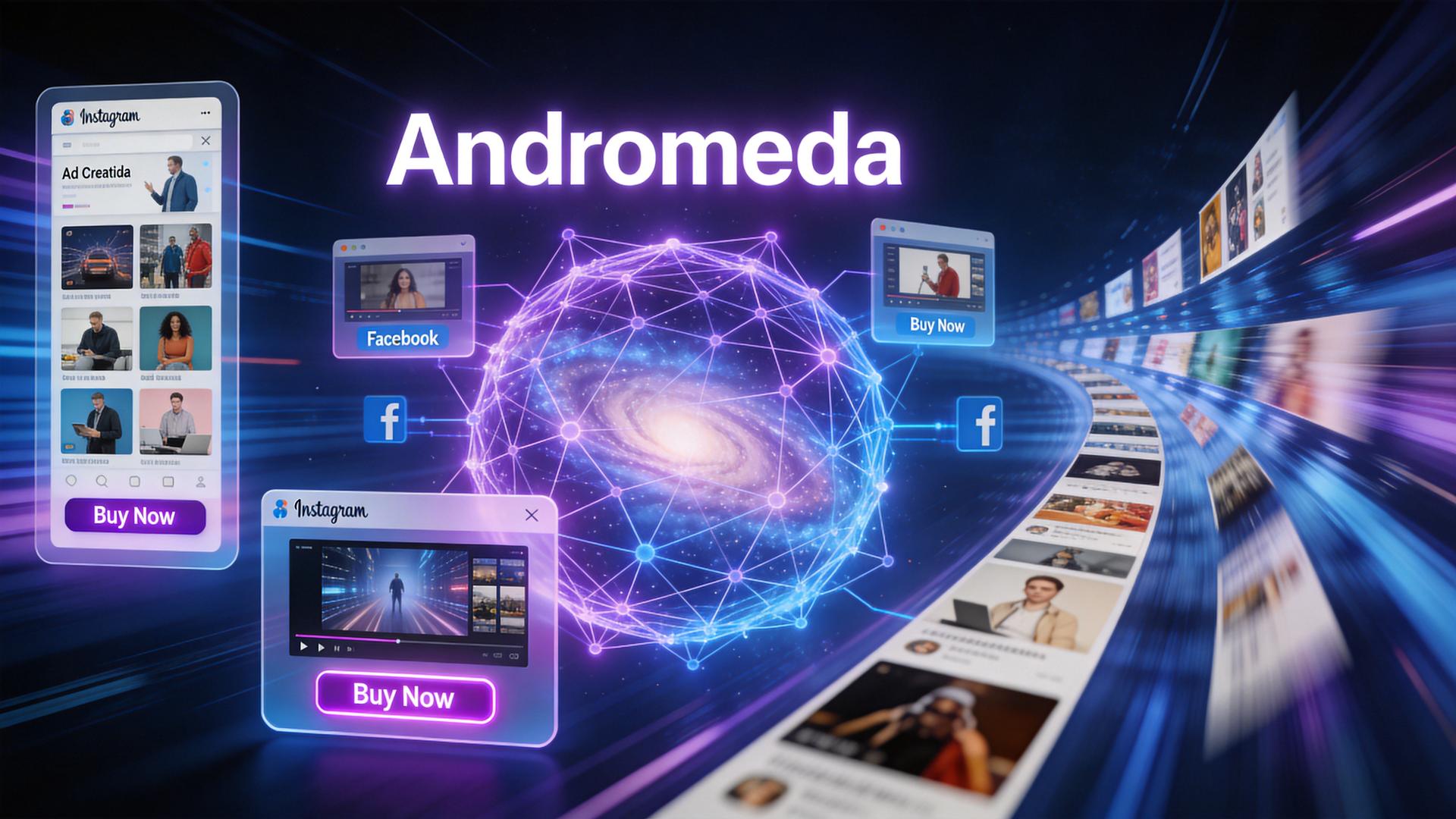
Andromeda is not just a regular update released every few months and then forgotten. It is a massive infrastructure built entirely on artificial intelligence, designed by Meta to analyze vast amounts of daily data and behaviors across Facebook, Instagram, and the entire Meta ad network.
The goal of this algorithm is to transcend the limits of the manual targeting we used to know, shifting control from the advertiser's hands to the quality of the content itself. The algorithm processes trillions of signals daily, learns from the behavior of each individual user, and decides which ad deserves to be shown to which person at any given moment.
In simple and direct terms: Meta is no longer asking, 'Who should see this ad?' It is now asking, 'Which ad will perform best for this person right now?' This is a radical shift that changes everything in how ad campaigns are built.
What exactly was Andromeda designed to do?
The algorithm processes trillions of signals daily to predict user behavior with unprecedented precision. It relies on deep neural networks to evaluate ad quality before spending any portion of the budget. It rewards ads that generate genuine engagement—like full views, clicks, or purchases—and penalizes those that seem artificial, repetitive, or create a negative user experience.
Most importantly: Andromeda learns from every ad you launch, and the more ad variations it has available, the faster it reaches the best possible performance.
This specific point is what changes the game for advertisers who are used to settling for just one or two ads per campaign.
Why did Meta build the Andromeda algorithm? The full story
1. The fallout of iOS 14 and digital privacy changes
Following the iOS 14 update in 2021 and the subsequent escalating restrictions on cookies and European/US privacy regulations, Meta lost a significant portion of the precise tracking data it relied upon to target users. Traditional targeting based on specific interests, preferences, and cross-site tracking became less reliable, and data gaps widened significantly.
Advertisers who relied on custom audiences built on Pixel data felt the impact immediately. Acquisition costs rose, conversion rates dropped, and statistical models became less accurate. Meta responded to this existential challenge by doubling down on artificial intelligence. The Andromeda algorithm is the direct result of this bet.
2. The explosion of Reels and short-form video content
Today's users consume massive amounts of Reels, Stories, and short video clips every single day. Competition with TikTok pushed Meta to invest heavily in the short video ecosystem, creating a massive technical challenge: How do you evaluate millions of new clips daily and decide which ones deserve to be shown to which user?
Meta needed an algorithm capable of instantly evaluating content quality, predicting engagement before spending the advertiser's budget, and continuously adapting to each user's preferences. Andromeda is the technical answer to this unprecedented digital explosion.
3. The escalating competition for user attention
The number of advertisers on Meta is constantly rising, and ad volume is increasing, while user attention remains static or declines. The old algorithm could no longer accurately distinguish between a good ad and an average ad. Andromeda stepped in to make this distinction with high computational precision, meaning that high-quality ads now get a larger share of impressions at a lower cost.
How did Andromeda radically change Meta ad optimization?
1. Your campaign's success depends on your creative, not your targeting
Previously, advertisers spent most of their time and effort building precise target audiences: layering interests, excluding custom audiences, and optimizing lookalikes. Today, broad targeting often outperforms traditional interest stacking.
The algorithm learns from the performance of the creative content itself, not from your preconceived assumptions about the audience. Meta Ads Academy explicitly confirms this reality: 'Creative is the most important factor in driving performance.' In other words, the ad itself has become the new targeting tool, not the audience.
2. One ad is absolutely no longer enough
Andromeda needs genuine creative diversity to learn and optimize. If you launch only one or two ads per ad set, you are depriving the algorithm of the data it needs to identify the true winner. The winners in the Andromeda era launch dozens of different variations: different messaging angles, diverse copy styles, and various visual formats ranging from static images to short videos and carousels.
This diversity does not mean randomness. Each version should test a specific hypothesis: What happens if I change the visual hook? How do results change if I focus on price instead of quality? This experimental logic is exactly what Andromeda rewards.
3. Speed always beats perfection
The faster you launch ads and test variations, the faster Meta learns. The shorter the learning phase, the lower your Cost Per Action (CPA) will be in the long run. Delaying ad launches under the pretext of 'achieving perfection' means losing valuable data and real sales opportunities every single day you delay.
The bitter truth proven by data: A 'good enough' ad today will outperform an 'absolutely perfect' ad launched two weeks later in most cases. The learning phase ends much faster when you give the algorithm a sufficient number of variations to learn from.
4. Genuine engagement is the new currency
Andromeda doesn't just evaluate your ad based on the Click-Through Rate (CTR). It monitors video watch time, purchase completion rates, comments, reactions, and even ads that users hide or report. An ad that generates positive engagement gets better bid prices and broader distribution at a lower cost. This is the true competitive advantage in the Andromeda era.
The biggest challenges facing advertisers and brands today
1. Traditional ad agencies are too slow
Producing a single ad through a traditional agency goes through multiple exhausting stages: an initial brief meeting, a creative concept pitch, client approval, studio shooting, edits and revision requests, a final presentation, and finally the launch. This process can take anywhere from 5 to 14 days at best.
By the time the ad is launched, the season might have changed, the competitor might have tested 20 variations and found a winner, or the market window might have closed. During critical seasons like Ramadan, Black Friday, or National Days, this slowness alone is enough to turn an entire ad budget into a loss.
2. Creative production costs weigh down any budget
To produce 20 ad variations with traditional professionalism, you need: graphic designers, photographers, actors or models, a video director, a copywriter, and an executive producer. Simple math makes testing at the scale Andromeda requires financially impossible for most mid-sized companies.
This dilemma keeps the gap wide between large corporations with massive production budgets and smaller businesses trying to compete with fewer resources. The winner is not the one with the biggest budget, but the one with the fastest creative production ecosystem.
3. Arabic ads remain a real, unresolved hurdle
For brands targeting the Arab market in the Gulf, Levant, and North Africa, the quality of Arabic copy is not just a linguistic detail; it's a direct performance factor. The Arab audience immediately detects a literally translated ad and feels it's a 'foreign' ad not designed for them.
Literal translations fail because they lack cultural context and Arabic linguistic logic. A phrase that works perfectly in English might seem cold, incomprehensible, or unintentionally funny in Arabic. The algorithm itself penalizes ads that fail to generate genuine engagement, which is exactly what happens with poor Arabic copy.
What does the Andromeda algorithm actually reward?
Based on Meta's published research, performance expert analysis, and documented case studies from real campaigns, high-performing ads in the Andromeda era share specific, measurable traits.
Specifications of a winning ad in the Andromeda era
First: Genuine creative diversity between 5 and 20 different variations per ad set. Not just changing the background color, but a real difference in the messaging and visual treatment.
Second: Content that feels native and familiar, like regular user-generated content, rather than an overly produced ad. 'Authentic' ads bypass ad fatigue barriers and achieve higher engagement.
Third: A strong and compelling hook within the first 3 seconds of a video or in the primary headline of a text ad. 80% of the decision to watch or scroll past is made in this brief moment.
Fourth: A clear value proposition and an offer too good to ignore. The user must understand within seconds why they should give you their attention.
Fifth: Regular content refreshing to prevent 'ad fatigue,' which occurs when the audience gets tired of seeing the same ad repeatedly and starts ignoring it.
Performance numbers you cannot ignore
Meta reports in its official documentation that advertisers who rely on true creative diversification achieve up to a 32% decrease in CPA compared to those who settle for limited variations. Brands that refresh their ad creatives weekly outperform competitors who stick to static content by 20% to 40% in performance metrics. Furthermore, video ads specifically optimized for the Reels format generate double the engagement compared to static ads among the same audiences.
How to adapt to the Andromeda algorithm and get the results you want?
Step One: Change the mindset before changing the tools
The first step isn't technical; it's psychological and methodological. Stop chasing the 'perfect' ad that everyone on the team agrees upon. The winning mindset in the Andromeda era is: 'We don't know which ad will succeed, so we will test them all and let the data decide.' This shift in thinking is both the most difficult and the most crucial step.
Step Two: Build a creative ecosystem built for speed
A successful advertising system today prioritizes speed over perfection, continuous testing over lengthy debates, and calculated volume over lavish production. The goal is not random output, but creating a system that allows you to test 10 to 20 variations in the time it takes a competitor to produce just one.
Step Three: Refresh content regularly and consistently
Set a weekly schedule to refresh your ad creative. Monitor 'ad fatigue' indicators like a declining CTR despite a stable budget, or a rising CPM. These are signals telling you that the audience is saturated and it's time to introduce new content.
Step Four: Invest in authentic Arabic content
If your market is the Arab world, investing in natively written Arabic content rather than translated text is not a luxury; it's a competitive necessity. Arab audiences reward ads that speak their true language with significantly higher engagement, sending positive signals to Andromeda, which in turn rewards you with broader distribution and lower costs.
The Role of Adflex in the Andromeda Era: The solution built for this moment
Adflex wasn't built to be a generic design tool or a traditional content platform. It was built specifically to tackle the challenge posed by the Andromeda algorithm: How do you produce ad content in sufficient volumes and at a speed that matches the algorithm itself, while maintaining the quality that drives real engagement?
Produce ads in minutes, not days
What used to take a week with a traditional agency is now done in a single session. Professional images, engaging videos, and performance-optimized ad copy—all produced in record time, allowing you to launch campaigns and start learning before your competitor catches up.
Unlimited variations for testing and optimization
Multiple strong hooks to test what grabs attention first. Diverse messaging angles to test what persuades the audience to buy. Different visual formats to match consumption behavior across Facebook, Instagram, and Reels. Everything the Andromeda algorithm needs to learn and optimize at top speed.
Arabic copy focused on performance, not translation
Adflex generates Arabic copy tailored specifically for audiences in the Gulf and the broader Arab world, taking into account the cultural context and linguistic style that generates real engagement. It's not a translation from English, nor is it generic copy that applies anywhere. It is Arabic content that speaks to the Arab audience in their native tongue.
No need for designers, agencies, or studios
The marketer can launch campaigns themselves, test continuously, and optimize daily without waiting a week to get a design back. This creative independence is what allows small teams to compete effectively against major corporations relying on massive agencies.
Practical Comparison: The Traditional Agency Path vs. The Adflex Path
The Traditional Agency Path
High production cost per ad.
Takes 5 to 14 days to produce a single version.
Limited variations due to financial and time constraints.
Slow optimization relying on weekly review sessions.
Complete dependency on the agency's availability and priorities.
The Andromeda-Ready Path with Adflex
Predictable and calculated cost for all production.
Takes minutes to produce a single version.
Dozens of variations per campaign at the same cost.
True daily optimization that matches the algorithm's speed.
Total independence in production and testing.
In the Andromeda era, the one who tests more wins more. The one who produces faster achieves better results. And the ultimate winner is not the one with the biggest budget—but the one with the fastest creative system.
The Arab Market and Andromeda: A special opportunity for the prepared
The Arab market represents a massive opportunity for those who know how to navigate it correctly. Facebook and Instagram usage rates in the Gulf, Egypt, and the Levant are among the highest globally, and the purchasing power in the Gulf countries makes the market highly attractive to brands across various sectors.
However, this opportunity comes with a clear challenge: The Arab audience does not tolerate content that feels imported and translated. An ad that succeeds in European or American markets does not automatically translate to success in Arab markets.
Brands that invest in genuine Arabic content—reflecting the audience's culture, interests, and way of expression—achieve results that far surpass those settling for mechanical translation. During critical seasons like Ramadan, Eid, and Black Friday, this gap widens exponentially.
What awaits us in the future of Meta Ads?
Based on Meta's public roadmap and published AI research from its engineering teams, the direction is clear, decisive, and indisputable: significantly less manual targeting, broader automation of distribution and optimization decisions, a deeper reliance on creative quality signals as the primary performance indicator, and higher rewards for advertisers who adopt rapid testing and experimentation as a methodology, not just an option.
This trend will not reverse. Meta is fully betting on a future where AI controls distribution and optimization decisions, which means your role as an advertiser has radically changed: You are no longer a targeter; you are a creative content supplier for a machine learning engine that creates the difference between you and your competitors.
Conclusion: Andromeda has changed the rules forever... Adapt or stay behind the competition
Meta's Andromeda algorithm is not a temporary update that will pass and be forgotten. It is a new operating system for digital advertising on Meta's platforms, and those who adapt early will build a competitive advantage that others will find hard to catch up with later.
Success now depends on four non-negotiable pillars: speed of production and launch, the volume and diversity of creative content, cultural relevance to the target audience (especially in the Arab market), and continuous testing driven by data, not opinions.
Traditional agencies alone will not be able to keep up with this accelerating pace. Manual systems will fall behind smart automation. Slow teams will lose their market share to faster, more adaptable competitors.
Adflex was built for exactly this moment. If you want to launch ads faster, test more ideas, win in the Arab market with authentic content, and stay ahead of Meta's algorithm... start with Adflex today.
🚀 Start your free trial with Adflex now:
Because in the Andromeda era... the fastest brands are the ones that win.